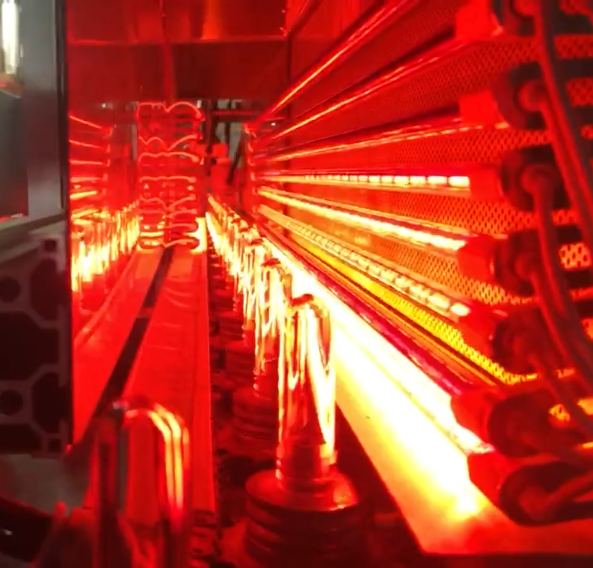
The heating tunnel on a Husky HyPET is where the whole run hangs together. If preform temperature isn’t locked in within a tight window, you get uneven stretch, crystallized shoulders, or weak necks—then the line starts chasing scrap, and speed goes out the window. I’ve seen this play out again and again: plants running older lamps, mismatched emitters, or “universal” replacements that hit the wattage on paper but drift in real life. The fallout isn’t just bad bottles. It’s wasted resin, restart losses, and maintenance tickets that keep coming back. So here’s the focus: a direct-fit infrared heater element built specifically for the Husky HyPET blow molder—designed to match the machine’s thermal behavior and hold a stable heating profile shift after shift.
What matters, technically
This HyPET heater element isn’t a generic halogen lamp. It’s a short-wave infrared emitter, built to drive heat into the preform wall quickly and predictably—without overshooting the surface. In practical terms, preforms heat fast and repeatably, so the blow station can run the intended cycle without fighting temperature drift. The specs are chosen to match the HyPET platform as it was engineered:
- **Technology:**Short-wave infrared (tungsten filament in a quartz envelope) for fast response and tight control.
- **Power:**Rated to match the OEM heating zone demand, so heat density stays consistent without re-tuning the whole tunnel.
- **Voltage:**Matched to the machine’s heater circuit (often 230 V depending on configuration), so you don’t need step-up transformers or field wiring changes.
- **Dimensions:**1:1 length and diameter to the original, so it drops into the same brackets, reflectors, and clearances.
- **Connector:**Correct termination—whether an R7s base or the HyPET-specific multi-pin interface—so the swap is clean without rewiring.
- **Spectral output:**Infrared energy tuned for PET absorption, narrowing the gap between setpoint and actual preform temperature. Why these choices matter: Short-wave infrared gives you fast start-up and fast cool-down. That translates into shorter restarts, fewer off-spec bottles after a stop, and less scrap during grade changes. Quartz holds up to repeated thermal cycling, and the matched electrical interface prevents the kind of control instability that shows up as overshoot or undershoot.
Why this works on a HyPET
On a Husky HyPET, the heating tunnel has to deliver a repeatable thermal profile hour after hour, across thousands of preforms. If emitter output drifts, the control loop chases it—and you end up with two headaches. First, quality suffers: uneven heating shows up as wall thickness swings, stress marks, or crystallization. Second, efficiency suffers: the machine slows to protect quality, or maintenance keeps swapping lamps. A Husky HyPET heater element is engineered for that exact environment.
- **Compatibility by design:**It mounts the same way and works within the same reflector geometry, so the heat pattern stays consistent across the preform path.
- **Stable output over life:**The spectral output is controlled, and filament behavior is managed, so the heating curve doesn’t shift as the lamp ages. Fewer sudden tweaks on the HMI, fewer scrap events.
- **Faster line restarts:**Short-wave infrared comes up to temperature quickly. After a jam, changeover, or short stop, the tunnel gets back to setpoint faster—so you lose less production.
- **Lower energy use in practice:**Because the element heats efficiently and holds setpoint without overshoot, you stop wasting energy correcting temperature. On long runs, that often shows up as a measurable drop in kWh per thousand bottles.
- **Fewer emergency calls:**Reliability here is about consistency. When lamps run their expected life and output stays stable, you stop replacing parts in a panic. That cuts downtime hours and the overtime that follows. On the floor, it looks like this:
- Less scrap after startup and changeovers.
- Fewer temperature-related rejects.
- Predictable preventive replacement instead of reactive failures.
- A heating section that behaves the way the HyPET was designed to run.
What to watch for
A direct-fit element is straightforward, but the details still matter. Here’s what to keep an eye on so the upgrade performs as intended.
- **Keep the control strategy intact:**The HyPET heater element is engineered for the machine’s original control logic. If you’ve changed PID settings, added aftermarket controllers, or swapped sensor types, verify the new lamp works within that loop. An unstable loop will beat up any heater.
- **Reflectors make or break output:**Even a good lamp underperforms if reflectors are oxidized, dirty, or out of alignment. Clean them, and confirm alignment when you install the new element.
- **Avoid mechanical stress:**Make sure the lamp is fully seated and that the holder supports the weight without putting bending stress on it. A bent mount can crack a quartz envelope.
- **Do the electrical checks before startup:**Confirm voltage at the terminal, verify the connector pins match, and check insulation. A connector that “looks right” can still cause arcing or intermittent contact.
- **Plan for real-world lamp life:**Infrared lamps are consumables. Actual life depends on voltage stability, how often you cycle, ambient temperature, and contamination. Track cycle hours, not calendar time, and keep spares on hand for scheduled maintenance. If you’re running a Husky HyPET and the heating section is costing you time, scrap, or maintenance hours, the fastest practical move is to put the heating system back into its original engineering intent—with a heater element built specifically for that machine. We supply the Husky HyPET heater element as a true 1:1 replacement: the right wattage, the right voltage, the right fit, and the right infrared behavior for PET heating. If you share your machine configuration and current lamp part number, we can confirm the exact termination and length for your unit.